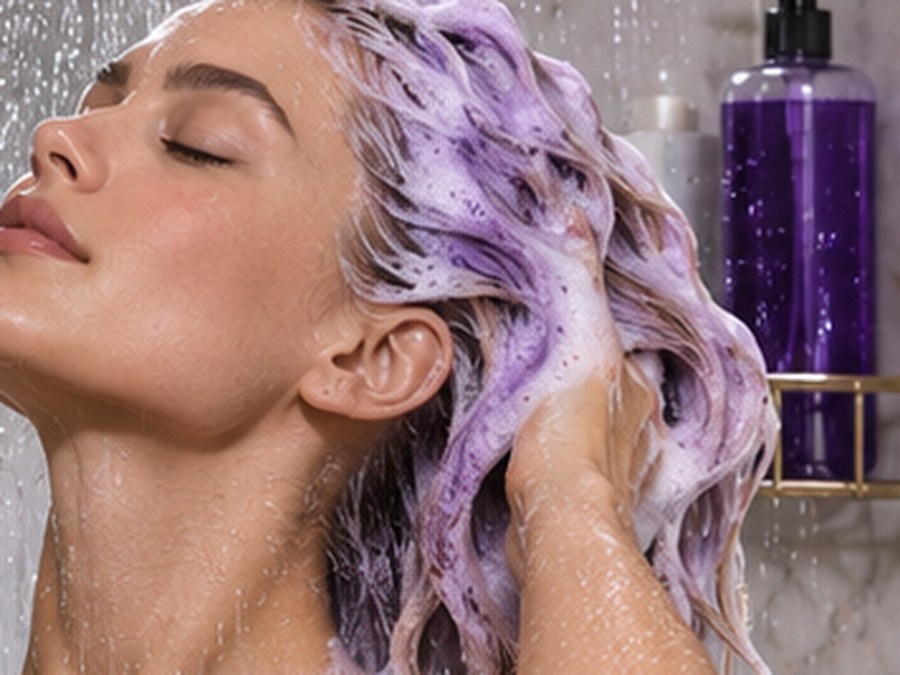
Color Theory & Optical Neutralization: The Law of Complements
On the traditional Oswald color wheel, purple (violet) sits directly opposite yellow. When hair is chemically lightened, melanin granules are oxidized, exposing underlying warm keratin tones (pale yellow at Level 9–10, and orange-yellow at Level 7–8).
Direct violet dyes (primarily Acid Violet 43) deposit a microscopic veil of cool pigment on the outer cuticle. When ambient light strikes this layer, the violet and yellow wavelengths absorb each other, reflecting as neutral, icy, or creamy beige light to the human eye.
Why Purple Shampoo Dries Out Blonde Strands
Direct dye pigments require an alkaline environment and strong surfactants to penetrate slightly into the open cuticle scales of bleached hair. When used too frequently (e.g., every wash), these surfactants strip away the hair's natural 18-MEA protective lipid barrier, leading to extreme porosity and breakage.
Furthermore, porous bleached ends absorb purple pigment far faster than healthy roots, resulting in dull, murky gray or muddy lavender tips. Always apply purple shampoo to roots first, pulling through ends only during the final 60 seconds of rinsing.