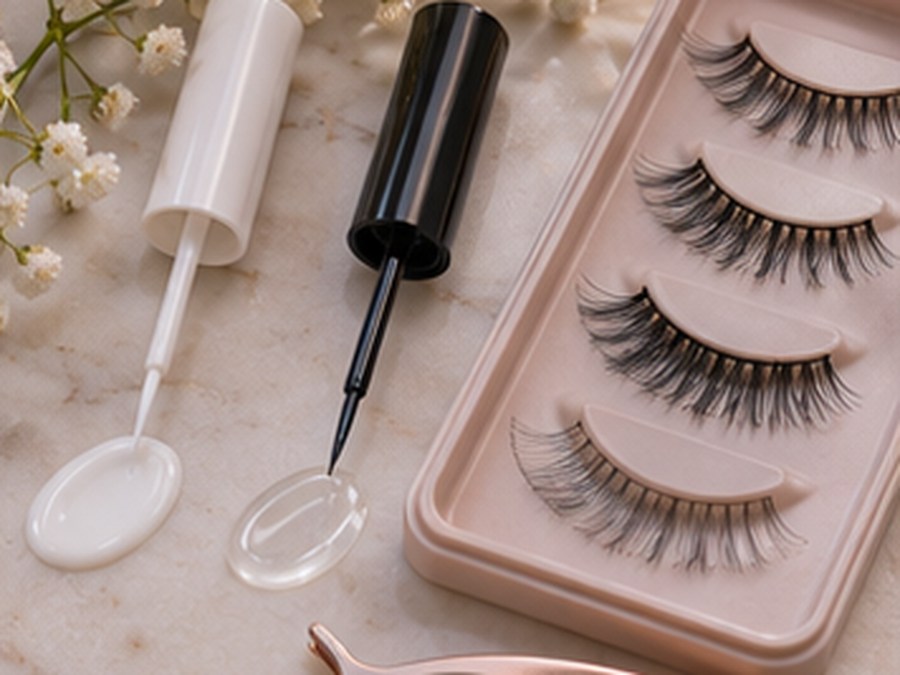
Adhesive Polymer Chemistry: Latex vs. Acrylates vs. Cyanoacrylate
Lash glues fall into three distinct chemical classes: 1. Natural Rubber Latex: Provides supreme elastic flexibility that bends with eyelid movement, but contains natural proteins that trigger severe allergic contact dermatitis in up to 8% of individuals.
2. Acrylates Copolymer (Latex-Free): Synthetic polymers dissolved in water that dry down into a clear, flexible, hypoallergenic film. Ideal for standard strip lashes. 3. Cyanoacrylate / Polyacrylate Resins: Used in professional extensions and under-lash clusters (like Falscara). These cure rapidly in the presence of ambient humidity, forming strong structural bonds that last multiple days without washing off.
The 30-Second Rule & Avoidance of Sliding
The number one reason false lashes lift at the inner corner is applying them while the glue is still wet. Wet glue has zero surface tension, causing the lash band to slide around, smear pigment across your eyelid, and pop off.
Paint a thin, uniform line of glue along the band, adding an extra micro-dot on the outer and inner corners. Wave the lash in the air for exactly 30 to 40 seconds. When the glue turns from milky white to translucent blue and feels tacky to a light fingertip touch, set it in place.