Curated Edit & Benchmarks
Tested Formulas & Top Recommendations
Best Overall Base Buffering Moisturizer (Layer 1)
La Roche-Posay Toleriane Double Repair Face Moisturizer
Formulated with prebiotic thermal spring water, ceramide-3, and 4% niacinamide. Absorbs instantly into skin to create a gentle, hydrating buffer that prevents retinoid irritation without blocking active penetration.
Best for: First-layer buffering, sensitive barriers, and soothing retinoid acclimation.
Check current price on Amazon
Best Beginner Encapsulated Retinol (Layer 2)
CeraVe Resurfacing Retinol Serum
A dermatologist-developed gentle retinol serum formulated with encapsulated vitamin A, licorice root extract, and three essential ceramides. Smooths texture and refines pores with minimal peeling.
Best for: Retinol beginners, sensitive skin, and gentle cellular turnover.
Check current price on Amazon
Best Sealing Barrier Cream (Layer 3)
La Roche-Posay Cicaplast Balm B5+ with Madecassoside
A multi-purpose soothing therapeutic balm packed with 5% panthenol (vitamin B5), madecassoside (cica), and zinc. Acts as an impenetrable healing shield over retinoids to eliminate morning flaking.
Best for: Top-layer sealing, extinguishing redness, and dry winter retinol regimens.
Check current price on Amazon
Best Clean Multi-Peptide Buffering Cream
Drunk Elephant Protini Polypeptide Cream
Packed with 9 signal peptides, pygmy waterlily extract, and soybean folic acid ferment. Buffers retinoids while infusing skin with essential amino acids for enhanced firming and bounce.
Best for: Clean beauty lovers, boosting collagen, and firming mature skin.
Check current price on Amazon
Best Clinical Retinal for Sandwich Layering
Medik8 Crystal Retinal 3 Stable Retinal Night Serum
Features patented encapsulated retinaldehyde that converts to active retinoic acid 11x faster than retinol. Formulated with hyaluronic acid and vitamin E for high-performance smoothing without dryness.
Best for: Fast wrinkle smoothing, acne-prone adult skin, and progressive strength laddering.
Check current price on Amazon
Editorial In-Depth
The Science, Methodology & Texture Guide
Pharmacology of Retinoid Dermatitis: Why Direct Application Stings
Vitamin A derivatives (retinol, retinal, tretinoin) are the most clinically proven anti-aging and anti-acne compounds in dermatology. However, when a concentrated retinoid is applied directly to freshly cleansed, bare skin, it encounters no lipid resistance.
The active molecules flood through the stratum corneum in a massive transdermal surge, binding to nuclear Retinoic Acid Receptors (RAR) on keratinocytes. This acute saturation triggers an inflammatory cascade known as 'retinoid dermatitis': mast cells degranulate, releasing histamine and pro-inflammatory cytokines that cause erythema, intense burning, shedding of desmosomes (flaking), and barrier compromise.
Biophysics of the Sandwich: Altering Diffusion Kinetics
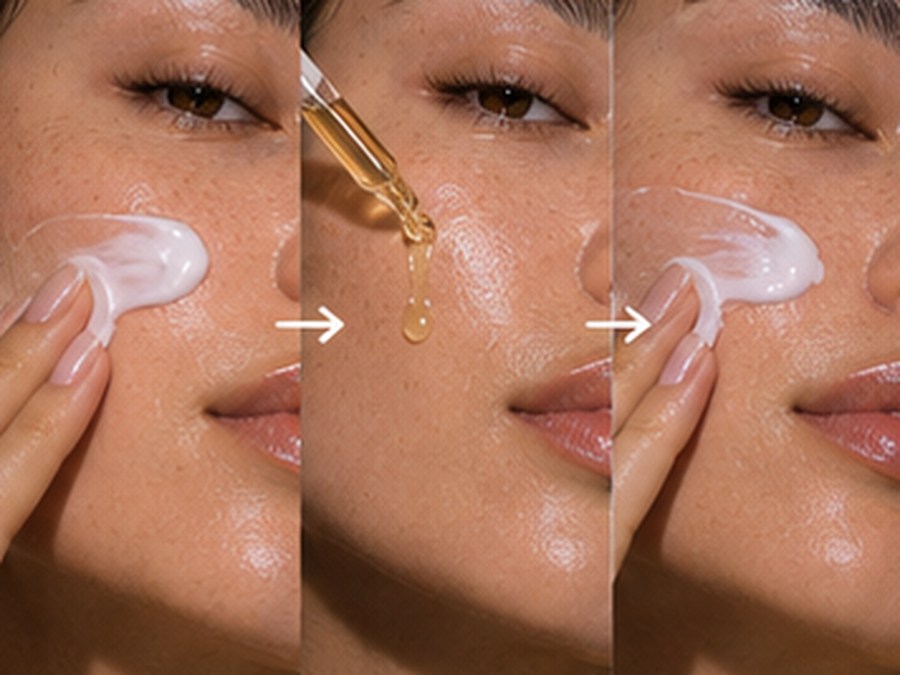
The Retinol Sandwich Method operates by fundamentally altering the Fick's Law diffusion kinetics of vitamin A across the stratum corneum. Applying a lightweight, humectant-rich moisturizer as Layer 1 fills the intercellular lipid pathways with water, ceramides, and fatty acids.
When the retinoid is applied 5 minutes later as the middle layer, it cannot immediately surge through the skin. Instead, the active molecules must slowly partition through the moisturizing buffer before reaching cellular receptors. This smooths out the peak drug concentration curve into an extended, gradual release. Layer 3 (the top sealing cream) locks the moisture inside, halting transepidermal water loss overnight.
Debunking the 'Dilution Myth': Does Sandwiching Weaken Retinol?
A frequent myth among skincare enthusiasts is that sandwiching retinol between moisturizers dilutes the active, rendering it completely ineffective. Clinical pharmacokinetics disprove this. Retinol is a small, lipophilic molecule with high transdermal permeability.
While sandwiching slows down the rate of absorption (reducing surface irritation by up to 80%), virtually 100% of the active molecules still successfully diffuse through into viable epidermal layers over an 8-hour sleep cycle. A gentle routine you can tolerate consistently 3 nights per week yields vastly superior clinical results compared to a harsh application that burns your skin and forces you to quit after 3 days.
Reader Inquiries
Key Solutions to Everyday Concerns
Can I use pure Vaseline or Aquaphor as the first layer in the sandwich?
No, absolutely not. 100% petrolatum is an impermeable occlusive barrier that blocks 99% of transdermal absorption. If you apply Vaseline as Layer 1, your retinol will sit on top and never penetrate into the skin. Use a lightweight lotion (like CeraVe or Toleriane) for Layer 1, saving heavy balms strictly for Layer 3.
How long should I use the sandwich method before applying retinol to bare skin?
Use the sandwich method for the first 4 to 8 weeks while your skin undergoes 'retinization' (upregulating cellular receptor density). Once your skin tolerates retinol with zero peeling or redness, you can experiment with applying retinol directly to clean, dry skin if desired.
How many nights a week should a beginner sandwich their retinol?
Start with the 'Rule of Twos': apply 2 nights per week for the first 2 weeks. If you experience no redness, advance to every other night for weeks 3 and 4, gradually building up to nightly application over 2 months.